Acho que este pincel despensa apresentações, o F80 da sigma é sem duvida o meu pincel preferido, eu uso-o para a base liquida, para base em pó, para o blush, essencialmente para tudo lol.
|
|
|---|
Showing posts with label Brushes. Show all posts
Sunday, June 19, 2011
Friday, February 25, 2011
Essence of Beauty Crease Brush Duo: BFF of My Small Eyes
Yes, it's official! The BFF of my teeny, puny, tiny little eyes is a pair of crease brushes. And it's none other than the famed Essence of Beauty Crease Brush Duo! I don't know why I took so long to buy myself a pair of these, but now that I finally have them, I have nothing but great things to say about them. In fact, I think I need to get a backup. Or two, or three, or four, or more!
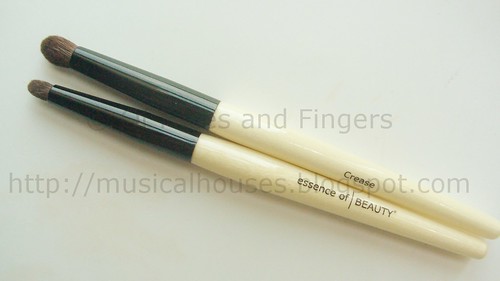
Essence of Beauty is a US-based drugstore brand, and can be found in CVS. The brand is pretty much loved for its range of brushes, but the Crease Brush Duo is definitely my favourite out of the various EOB (Essence of Beauty) brushes I've tried. The Crease Brush Duo, as the name suggests, consist of two small crease brushes in a tiny little plastic ziplock packaging:

Both brushes have black ferrules and light handles, and both brushes are marked "Crease", which I think is kind of cute. These brushes are actually smaller than your average crease brush, which I think makes them perfect for small eyes which don't have much lid space.
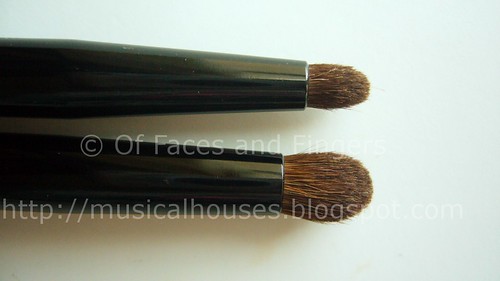
The larger of the two brushes is a domed brush for blending, while the smaller of the two brushes has tapered bristles resembling a pencil brush. The larger domed brush is great for blending out eyeshadow, while the smaller one is great for applying eyeshadow to tight areas, or applying eyeshadow as eyeliner, or even blending out very teeny tiny areas (like the corners of your eyes).

The brushes themselves are made of natural hair. It's not particularly awesome quality natural hair, to be honest - the bristles are a little stiffer than some other brands that have good quality bristles (e.g. Stila). However, they're pretty good for the drugstore price, and definitely comfortable to use. They're just not, you know, THE best out there.
But the quality of the bristles isn't what makes this duo so brilliant. It's the fact that the brush tips have a rounded shape, and that the bristle length and density are just perfect. The larger domed crease brush is one of my major loves right now - it has enough bristles to feel firm to the touch, allowing it to pick up and apply eyeshadow to the crease, and yet, the bristles aren't so tightly packed together that it makes blending difficult. The pencil brush is also the right length, allowing for bristle flexibility that still retains some brush firmness.

Another thing I love about these two brushes is that they're small, so they fit very nicely into the contour area of my puny little eyes. I still love my Stila #9 All Over Blending Brush, but for small or tight spaces, when the Stila brush is too big, I find the EOB brushes give a more precise application that is still blended. It's much easier blending smaller areas of eyeshadow with the EOB brushes, as the smaller brush surface mean that the risk of overblending areas you don't wish to blend is lessened.
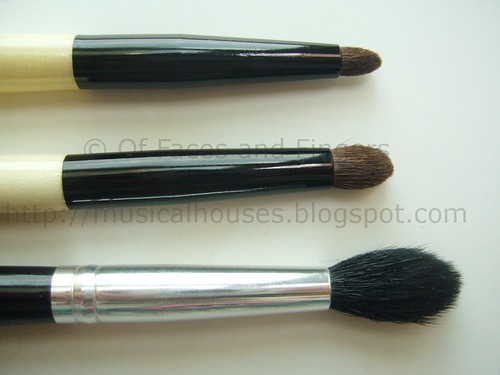
Here are the brushes next to the Stila #9 for comparison. As you can see, they are a lot smaller, and the bristles are more tightly packed together.

So do you need this? Of course you do! If you, like me, have small puny eyes, then you need this for blending colour in your contour or crease area. If you like to do precise work with your eyeshadow, and need a brush to blend out small areas of eyeshadow, then you need this. If you find the average blending brush too large, and wish for a smaller blending brush for your eye area, then you need this. I mean, what's not to like? It's cheap, it's good, and it works a treat. My eyes are totally in love with this brush duo. It's definitey worth a shot - and if you don't like it, send it my way, because I'm looking for backups!
Essence of Beauty is a US-based drugstore brand, and can be found in CVS. The brand is pretty much loved for its range of brushes, but the Crease Brush Duo is definitely my favourite out of the various EOB (Essence of Beauty) brushes I've tried. The Crease Brush Duo, as the name suggests, consist of two small crease brushes in a tiny little plastic ziplock packaging:

Both brushes have black ferrules and light handles, and both brushes are marked "Crease", which I think is kind of cute. These brushes are actually smaller than your average crease brush, which I think makes them perfect for small eyes which don't have much lid space.
The larger of the two brushes is a domed brush for blending, while the smaller of the two brushes has tapered bristles resembling a pencil brush. The larger domed brush is great for blending out eyeshadow, while the smaller one is great for applying eyeshadow to tight areas, or applying eyeshadow as eyeliner, or even blending out very teeny tiny areas (like the corners of your eyes).

The brushes themselves are made of natural hair. It's not particularly awesome quality natural hair, to be honest - the bristles are a little stiffer than some other brands that have good quality bristles (e.g. Stila). However, they're pretty good for the drugstore price, and definitely comfortable to use. They're just not, you know, THE best out there.
But the quality of the bristles isn't what makes this duo so brilliant. It's the fact that the brush tips have a rounded shape, and that the bristle length and density are just perfect. The larger domed crease brush is one of my major loves right now - it has enough bristles to feel firm to the touch, allowing it to pick up and apply eyeshadow to the crease, and yet, the bristles aren't so tightly packed together that it makes blending difficult. The pencil brush is also the right length, allowing for bristle flexibility that still retains some brush firmness.

Another thing I love about these two brushes is that they're small, so they fit very nicely into the contour area of my puny little eyes. I still love my Stila #9 All Over Blending Brush, but for small or tight spaces, when the Stila brush is too big, I find the EOB brushes give a more precise application that is still blended. It's much easier blending smaller areas of eyeshadow with the EOB brushes, as the smaller brush surface mean that the risk of overblending areas you don't wish to blend is lessened.
Here are the brushes next to the Stila #9 for comparison. As you can see, they are a lot smaller, and the bristles are more tightly packed together.

So do you need this? Of course you do! If you, like me, have small puny eyes, then you need this for blending colour in your contour or crease area. If you like to do precise work with your eyeshadow, and need a brush to blend out small areas of eyeshadow, then you need this. If you find the average blending brush too large, and wish for a smaller blending brush for your eye area, then you need this. I mean, what's not to like? It's cheap, it's good, and it works a treat. My eyes are totally in love with this brush duo. It's definitey worth a shot - and if you don't like it, send it my way, because I'm looking for backups!
Thursday, February 3, 2011
Reader Question: Tips for Cleaning Makeup Brushes
Brush cleaning is something every makeup fanatic (or makeup user, for that matter), has to know how to do. So since I got a question about how I clean my brushes on my Formspring page, I figure I might as well cross-post it to my blog, because, well, we all need to wash our brushes, don't we? :) I need to do some sort of actual brush-cleaning post with pictures one day, but for now, here's just the words with no pictures.
Q: How do you wash your makeup brushes? Thanks =D
In order to clean the brushes, you'll need a supply of water (I do this in my bathroom), some brush cleaner, and a bunch of paper towels (or a cloth towel), as well as a place to let your brushes air dry.
First, I wet the bristles of my brushes a bit, and then I apply a bit of brush cleaner to the bristles and sort of gently swirl the bristles around in the cleaner. If the brush is very dirty I also gently rub some cleaner into the bristles using my fingers. After that, I rinse the brush bristles to remove the cleaner and gunk, and then I very gently squeeze any excess water out of the bristles with my fingertips. Afterwards, I try to get my brush as dry as possible using the towel or paper towels. I usually do this by gently pressing the bristles against the towels, or by running the brush back and forth against the towels. It's important to try to get as much water out of the brushes before you leave them to air dry, so that the drying time is shorter. After I think I've gotten as much water out as I can, I leave them lying flat on a small towel in a well-ventilated place, and let them air dry. It usually takes about 2 days for the brushes to fully dry, although thick, synthetic brushes (e.g. like a synthetic kabuki) can take longer.
The entire process can be pretty laborious because you have to do it by hand, one brush at a time. Three very important tips I can give you for cleaning brushes are:
1. Use the right cleaner, not just any soap or detergent. You can get brush cleaner from most stores (I know MAC has one that's pretty good, and can be diluted with water when used to make it last longer), but if you don't use brush cleaner, it's OK too. The main thing is to make sure that whatever you're using isn't too harsh or drying on the bristles, especially if they are made of natural hair. If your bristles feel dry or scratchy after they have dried, you know the cleaner you've used is too harsh. I personally like to use my Biore makeup remover gel for washing my brushes, because it gets out all the gunk but doesn't dry the bristles out. Other alternatives to brush cleaner that are popular are baby shampoo, as well as Dr Bronner's Castille Soap. Some people also use handsoap, though once again I'd be careful to make sure that the handsoap you're using isn't too harsh on the bristles.
2. Be gentle. Be very, very gentle. Some brushes shed hair, or bleed dye when washed. That is normal, especially if it is the first couple of times you're washing the brush. Subsequently, hair should shed less, and dye bleeding should lessen also. However, you also want to be very gentle with your brushes when you wash and dry them, so you don't excerbate the shedding or bleeding.
3. When you wash your brushes, be very careful to only wet the bristles, and not the ferrule. The ferrule is the part which joins the bristles to the handle of the brush. Most brands just fix the ferrule with glue, which means that repeated wetting of the ferrule will eventually weaken the glue and cause your bristles to come loose. That's a scary thought, isn't it? So it's important to make sure that the ferrule doesn't get wet unnecessarily, and is thoroughly dried. I just make sure I wet the brush and stop before the ferrule, instead of drowning the entire head of the brush in water. And it's also important to get the brush as dry as possible before letting it air dry (hence the activity with the towels), and also, it's equally important that the brushes are left flat (as opposed to upright) to dry.
Well, those are my tips for brush cleaning, and I hope they help you!
Q: How do you wash your makeup brushes? Thanks =D
In order to clean the brushes, you'll need a supply of water (I do this in my bathroom), some brush cleaner, and a bunch of paper towels (or a cloth towel), as well as a place to let your brushes air dry.
First, I wet the bristles of my brushes a bit, and then I apply a bit of brush cleaner to the bristles and sort of gently swirl the bristles around in the cleaner. If the brush is very dirty I also gently rub some cleaner into the bristles using my fingers. After that, I rinse the brush bristles to remove the cleaner and gunk, and then I very gently squeeze any excess water out of the bristles with my fingertips. Afterwards, I try to get my brush as dry as possible using the towel or paper towels. I usually do this by gently pressing the bristles against the towels, or by running the brush back and forth against the towels. It's important to try to get as much water out of the brushes before you leave them to air dry, so that the drying time is shorter. After I think I've gotten as much water out as I can, I leave them lying flat on a small towel in a well-ventilated place, and let them air dry. It usually takes about 2 days for the brushes to fully dry, although thick, synthetic brushes (e.g. like a synthetic kabuki) can take longer.
The entire process can be pretty laborious because you have to do it by hand, one brush at a time. Three very important tips I can give you for cleaning brushes are:
1. Use the right cleaner, not just any soap or detergent. You can get brush cleaner from most stores (I know MAC has one that's pretty good, and can be diluted with water when used to make it last longer), but if you don't use brush cleaner, it's OK too. The main thing is to make sure that whatever you're using isn't too harsh or drying on the bristles, especially if they are made of natural hair. If your bristles feel dry or scratchy after they have dried, you know the cleaner you've used is too harsh. I personally like to use my Biore makeup remover gel for washing my brushes, because it gets out all the gunk but doesn't dry the bristles out. Other alternatives to brush cleaner that are popular are baby shampoo, as well as Dr Bronner's Castille Soap. Some people also use handsoap, though once again I'd be careful to make sure that the handsoap you're using isn't too harsh on the bristles.
2. Be gentle. Be very, very gentle. Some brushes shed hair, or bleed dye when washed. That is normal, especially if it is the first couple of times you're washing the brush. Subsequently, hair should shed less, and dye bleeding should lessen also. However, you also want to be very gentle with your brushes when you wash and dry them, so you don't excerbate the shedding or bleeding.
3. When you wash your brushes, be very careful to only wet the bristles, and not the ferrule. The ferrule is the part which joins the bristles to the handle of the brush. Most brands just fix the ferrule with glue, which means that repeated wetting of the ferrule will eventually weaken the glue and cause your bristles to come loose. That's a scary thought, isn't it? So it's important to make sure that the ferrule doesn't get wet unnecessarily, and is thoroughly dried. I just make sure I wet the brush and stop before the ferrule, instead of drowning the entire head of the brush in water. And it's also important to get the brush as dry as possible before letting it air dry (hence the activity with the towels), and also, it's equally important that the brushes are left flat (as opposed to upright) to dry.
Well, those are my tips for brush cleaning, and I hope they help you!
Friday, January 14, 2011
Sigma Angled Top Kabuki F84: Contour and Buff at One Go
Sigma is a beauty brand hailing from the USA, and the brand is most famous for its makeup brushes. That's no surprise - the ones I've tried have been actually worth the price. Good makeup brushes don't come cheap, and some of the most famous brushes (Trish Mcevoy, Shu Uemura, etc) can be prohibitively expensive for a girl on a budget, so it's always great to find a brand that manages to combine both quality and price into one package.
The Sigma Angled Top Kabuki F84, is one-third of the recently-released Sigma Synthetic Face Kit, which I've also briefly reviewed previously. Today's post, as part of my journey to delve into each individual brush in the kit in greater detail, focuses on the Angled Top Kabuki F84. (In case you've missed it, I've previously looked at the Flat Top Kabuki and the Round Top Kabuki previously.)

Of all the three kabukis in the Sigma Synthetic Face Set, I have to say this is probably my favourite, probably because it's the most versatile. I love the angled shape, which makes it very handy for applying blush, bronzer, or contouring products. And although this is a kabuki brush, its use doesn't stop at buffing. I think this one could actually apply products, should you wish to use a heavier hand. I think it would be great to apply lightly pigmented products that need building up, because the bristles do tend to pick up quite a bit of product.
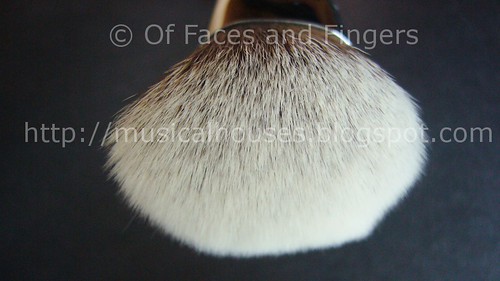
Another thing I like about the Angled Top Kabuki is the qualaity of the bristles. These are synthetic bristles that are very fine and soft. I find them comparable in quality to the bristles of some of the other brands with great synthetic brushes, like Urban Decay, The Body Shop, Too Faced, and Ecotools. As far as bristles go, I can't fault this one.

Because the bristles are made out of synthetic material, these brushes are pretty nifty for applying cream and liquid products, in addition to powder. Unlike natural bristles, synthetic bristles don't soak up liquids, so that makes them good for applying cream, gel, and liquid products.
So do you need this brush? I'd say yes, if you use mineral blush, bronzer, or contouring products that require you to buff and blend, or if you've been looking for a contouring brush to apply liquid and cream blushes and bronzers with. The Angled Top Kabuki is of good quality, so if it suits your needs, it's worth checking out.
(Product was provided for review. Review is my complete and honest opinion. I am not compensated by or affiliated with the company in any way.)
The Sigma Angled Top Kabuki F84, is one-third of the recently-released Sigma Synthetic Face Kit, which I've also briefly reviewed previously. Today's post, as part of my journey to delve into each individual brush in the kit in greater detail, focuses on the Angled Top Kabuki F84. (In case you've missed it, I've previously looked at the Flat Top Kabuki and the Round Top Kabuki previously.)

Of all the three kabukis in the Sigma Synthetic Face Set, I have to say this is probably my favourite, probably because it's the most versatile. I love the angled shape, which makes it very handy for applying blush, bronzer, or contouring products. And although this is a kabuki brush, its use doesn't stop at buffing. I think this one could actually apply products, should you wish to use a heavier hand. I think it would be great to apply lightly pigmented products that need building up, because the bristles do tend to pick up quite a bit of product.
Another thing I like about the Angled Top Kabuki is the qualaity of the bristles. These are synthetic bristles that are very fine and soft. I find them comparable in quality to the bristles of some of the other brands with great synthetic brushes, like Urban Decay, The Body Shop, Too Faced, and Ecotools. As far as bristles go, I can't fault this one.

Because the bristles are made out of synthetic material, these brushes are pretty nifty for applying cream and liquid products, in addition to powder. Unlike natural bristles, synthetic bristles don't soak up liquids, so that makes them good for applying cream, gel, and liquid products.
So do you need this brush? I'd say yes, if you use mineral blush, bronzer, or contouring products that require you to buff and blend, or if you've been looking for a contouring brush to apply liquid and cream blushes and bronzers with. The Angled Top Kabuki is of good quality, so if it suits your needs, it's worth checking out.
(Product was provided for review. Review is my complete and honest opinion. I am not compensated by or affiliated with the company in any way.)
Saturday, January 8, 2011
Sonia Kashuk Synthetic Flat Top Brush vs Sigma Round Top Kabuki: A Comparison
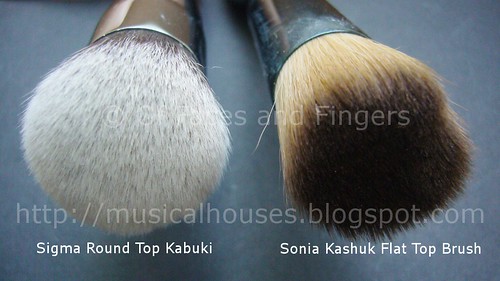
A synthetic flat-top brush is a necessity if you work with liquids and creams often. It's very useful for applying liquid or cream foundation, as well as other cream products, like brush. I was recently playing around with my Sigma Beauty Round Top Kabuki Brush F82, and I realized it was actually pretty similar to another brush in my collection, the much-acclaimed Sonia Kashuk Synthetic Flat Brusher Blush.
Although it's billed as a brusher blush, the Sonia Kashuk Synthetic Flat Top Brush h has been getting raves for liquid foundation application. Two Sigma brushes I have, the Flat Top Kabuki F80, as well as the Round Top Kabuki F82, are quite similar to the brushes. Since I've already talked about the Flat Top Kabuki before, I thought I'd deal with the Round Top Kabuki in this one.

Both brushes are similar, and both are of surprisingly good quality, considering the price. Both have synthetic bristles, and the bristles are quite densely packed. Both also have a similar brush diameter. In many respects, the similarities in bristle type and density mean that both brushes will be pretty similar. If you liked the Sonia Kashuk for liquid application, you'd probably like the Sigma Kabuki for a similar effect, too. If you liked the Sonia Kashuk for buffing and blending, you'd probably like the Sigma Round Top for the same, too. And if you liked the small, handy size of the Sonia Kashuk brush for working around tiny areas of the face, like the nose, then the Sigma Kabuki would perform in exactly the same way.
That said, there are some slight differences. The Sonia Kashuk Flat Top Brush has bristles that are slightly longer than the sigma Kabuki, and the Sigma Round Top Kabuki has a brush shape that is slightly rounded at the sides, whereas the Sonia Kashuk is totally flat. Thus, the Sigma brush is more likely to give a denser application of product as compared to the Sonia Kashuk brush. Also, some people might prefer the rounded shape of the Sigma Kabuki, as they feel it might help them maneuver around the contours of their faces better. The differences may not be very noticeable, but I'm splitting hairs for the sake of a review here.

So which one do you need? Well, I'd say both are pretty compable, and I guess ultimately which one you end up with would depend on which one is available. For girls who live outside of the USA (or for that matter, within the USA but far away from a Target), where Sonia Kashuk is unavailable or hard to get, then the Sigma Round Top Kabuki or Flat Top Kabuki would be a very close substitute. Sigma Beauty does ship worldwide, so it's easily gotten hold of.
(The Sigma brush was sent to me for review. Review is my complete and honest opinion. I am not compensated or affiliated with the company in any way.)
Although it's billed as a brusher blush, the Sonia Kashuk Synthetic Flat Top Brush h has been getting raves for liquid foundation application. Two Sigma brushes I have, the Flat Top Kabuki F80, as well as the Round Top Kabuki F82, are quite similar to the brushes. Since I've already talked about the Flat Top Kabuki before, I thought I'd deal with the Round Top Kabuki in this one.

Both brushes are similar, and both are of surprisingly good quality, considering the price. Both have synthetic bristles, and the bristles are quite densely packed. Both also have a similar brush diameter. In many respects, the similarities in bristle type and density mean that both brushes will be pretty similar. If you liked the Sonia Kashuk for liquid application, you'd probably like the Sigma Kabuki for a similar effect, too. If you liked the Sonia Kashuk for buffing and blending, you'd probably like the Sigma Round Top for the same, too. And if you liked the small, handy size of the Sonia Kashuk brush for working around tiny areas of the face, like the nose, then the Sigma Kabuki would perform in exactly the same way.
That said, there are some slight differences. The Sonia Kashuk Flat Top Brush has bristles that are slightly longer than the sigma Kabuki, and the Sigma Round Top Kabuki has a brush shape that is slightly rounded at the sides, whereas the Sonia Kashuk is totally flat. Thus, the Sigma brush is more likely to give a denser application of product as compared to the Sonia Kashuk brush. Also, some people might prefer the rounded shape of the Sigma Kabuki, as they feel it might help them maneuver around the contours of their faces better. The differences may not be very noticeable, but I'm splitting hairs for the sake of a review here.

So which one do you need? Well, I'd say both are pretty compable, and I guess ultimately which one you end up with would depend on which one is available. For girls who live outside of the USA (or for that matter, within the USA but far away from a Target), where Sonia Kashuk is unavailable or hard to get, then the Sigma Round Top Kabuki or Flat Top Kabuki would be a very close substitute. Sigma Beauty does ship worldwide, so it's easily gotten hold of.
(The Sigma brush was sent to me for review. Review is my complete and honest opinion. I am not compensated or affiliated with the company in any way.)
Tuesday, January 4, 2011
Sigma Flat Top Kabuki vs MAC 187: A Comparison
The MAC 187 is one of the most famous makeup brushes in makeupdom. I remember when I was a newbie to the makeup world, everyone I knew had one, wanted one, or thought it was absolutely necessary to have one. Over time, of course, dupes and similar brushes came out. And since I'm doing a review on the Sigma Flat Top Synthetic Kabiki F80, I thought I'd photograph the two brushes next to each other, since they do appear to be similar.
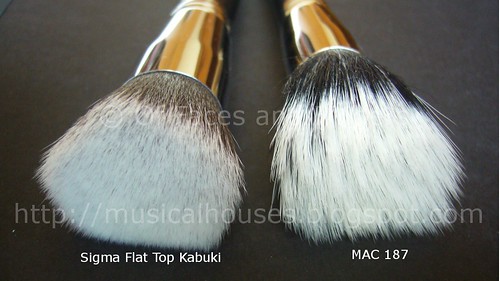
Both brushes have comparable handle length, and bristle colour. You can see below that they are of a similar size, so if you liked the MAC 187's size, you'd probably like the Sigma Flat Top Kabuki as well. The quality of both brushes is also very good - I have to admit that I wasn't expecting much from a Sigma brush - after all, nothing lives up to its hype, right? - but I am forced to admit that the Sigma brush is actually of much better quality than I expected.

Top: Sigma Flat Top Kabuki, Bottom: MAC 187
However, despite their similarities, they perform totally different functions. After all, the MAC 187 is a duo fiber/skunk/stippling brush (whichever terminology you prefer), while the Sigma Flat Top Kabuki, is well, a kabuki/buffing brush. In short, this means that the MAC 187 would be bettr for applying product in a sheer, sparing manner (e.g. for heavily pigmented blushes or foundations), while the Sigma Kabuki would be best for buffing, or blending (e.g. blending after all product is applied, or buffing in mineral makeup). But let's explore the brushes a little more.

The MAC 187 has bristles that are a lot less dense than the Sigma Kabuki. So for more pigmented products, the 187 might be a better choice, since less product will be picked up and deposited. However, for sheerer products, the Sigma Kabuki would be better, as it can really pack on product.
Also, the MAC 187 has natural bristles, as opposed to the Sigma Kabuki which has synthetic bristles. While there are no hard and fast rules for what brush goes with what product, it has been my general experience that natural bristles do better with powder products, while synthetic bristles work better with cream, liquid, or gel products. With natural bristles, they deposit powder products evenly, but if used with liquid products, the bristles tend to absorb some of the moisture from the product, making application uneven. On the other hand, synthetic bristles tend to work well with liquids and creams because they don't absorb any moisture, however I do find that for some reason they don't deposit as much powder as natural bristles do. For some reason the powder just seems to get "trapped" in synthetic bristles, but not in natural hair ones.
So, although they might look similar, they actually aren't when it comes to function. The MAC 187 is better for powder products, and for products that are more pigmented, while the Sigma kabuki works well with cream, liquid and gell products, and also for products that are more sheer. The 187 is a stippling brush, while the kabuki is a buffing brush. They actually complemnt each other very well in that regard. Well worth owning both, in my opinion.
(The Sigma brush was sent to me for review. Review is my own honest and complete opinion. I am not affiliated with/compensated by the company for this review.)
Both brushes have comparable handle length, and bristle colour. You can see below that they are of a similar size, so if you liked the MAC 187's size, you'd probably like the Sigma Flat Top Kabuki as well. The quality of both brushes is also very good - I have to admit that I wasn't expecting much from a Sigma brush - after all, nothing lives up to its hype, right? - but I am forced to admit that the Sigma brush is actually of much better quality than I expected.

Top: Sigma Flat Top Kabuki, Bottom: MAC 187
However, despite their similarities, they perform totally different functions. After all, the MAC 187 is a duo fiber/skunk/stippling brush (whichever terminology you prefer), while the Sigma Flat Top Kabuki, is well, a kabuki/buffing brush. In short, this means that the MAC 187 would be bettr for applying product in a sheer, sparing manner (e.g. for heavily pigmented blushes or foundations), while the Sigma Kabuki would be best for buffing, or blending (e.g. blending after all product is applied, or buffing in mineral makeup). But let's explore the brushes a little more.

The MAC 187 has bristles that are a lot less dense than the Sigma Kabuki. So for more pigmented products, the 187 might be a better choice, since less product will be picked up and deposited. However, for sheerer products, the Sigma Kabuki would be better, as it can really pack on product.
Also, the MAC 187 has natural bristles, as opposed to the Sigma Kabuki which has synthetic bristles. While there are no hard and fast rules for what brush goes with what product, it has been my general experience that natural bristles do better with powder products, while synthetic bristles work better with cream, liquid, or gel products. With natural bristles, they deposit powder products evenly, but if used with liquid products, the bristles tend to absorb some of the moisture from the product, making application uneven. On the other hand, synthetic bristles tend to work well with liquids and creams because they don't absorb any moisture, however I do find that for some reason they don't deposit as much powder as natural bristles do. For some reason the powder just seems to get "trapped" in synthetic bristles, but not in natural hair ones.
So, although they might look similar, they actually aren't when it comes to function. The MAC 187 is better for powder products, and for products that are more pigmented, while the Sigma kabuki works well with cream, liquid and gell products, and also for products that are more sheer. The 187 is a stippling brush, while the kabuki is a buffing brush. They actually complemnt each other very well in that regard. Well worth owning both, in my opinion.
(The Sigma brush was sent to me for review. Review is my own honest and complete opinion. I am not affiliated with/compensated by the company for this review.)
Sunday, January 2, 2011
Sigma Synthetic Face Kit Kabuki Brushes Comparison: Angled, Flat Top and Round
Happy New Year everyone! I hope you have had great fun counting down to 2011! I thought I'd start the new year trying out a brand I've never reviewed before - Sigma Beauty. They have been out there in the blogosphere for awhile due to their brushes, and while there have been some differences in opinion, in general it seems that Sigma's brushes garner glowing reviews, complete with dupes for MAC brushes. I was pretty skeptical of the reviews (really, you expect me to believe that EVERY self-proclaimed Youtube "guru" loves these brushes?), and it appeared that there was only one way for me to discover whether these were really worth the hype or not. And that's how I ended up with a few Sigma brushes.
It can be pretty daunting picking from Sigma's wide array of makeup brushes. Sigma only does brushes and accessories, so you can imagine how specialized they are. They have a gazillion face brushes, so out of those I zoomed in on three that looked interesting. These are three kabuki brushes, in various shapes that intrigued me. While most brands only have one single kabuki brush, Sigma has three! How's that for variety?
The three kabuki brushes shown here are the Round Top Kabuki F82, the Angled Top Kabuki, F84, and the Flat Top Synthetic Kabuki, F80. They are arranged in that order from top to bottom in this photo:

Although only the Flat Top Synthetic Kabuki F80 lists itself as being synthetic, all three brushes are synthetic, and made of the same type of brush bristle. The bristles are actuay quite soft and well-formed, and remind me of the same synthetic bristles used by Too Faced and The Body Shop, two other brands with popular brands of synthetic brushes. The bristles are also very well-packed, as one might expect of a good quality kabuki brush - definitely no floppy bristles here! These brushes were definitely made to buff. Another thing I like about the bristles is that because they are synthetic, these brushes are good for applying not solely powder, but also cream, liquid, and gel products. Natural hair brushes tend to "soak up" liquid products, so for any liquid-based product, synthetic brushes tend to be more ideal.
The handles and ferrules of the brushes are also pretty sturdy - definitely no hair falling off, or no glue coming un-sticky. They were actually of much better quality than I expected them to be. The handles are all the same length, and are pretty uniform.
So now you must be wondering - if they're all kabukis, what's the difference between them? Well, first of all, there is shape. The Round Top Kabuki, Flat top Kabuki, and Angled Top Kabuki all have different shapes. Pretty obvious, right? But there is also bristle length. The Round Top Kabuki F82 is the brush with the shortest bristles, while the Angled Top Kabuki F84 has the longest bristles. Also, although all the brushes have tightly-packed bristles, there is still slight variance in the density of the bristles. The Round Top Kabuki has the densest bristles, while the Angled Top has the sparsest bristles.
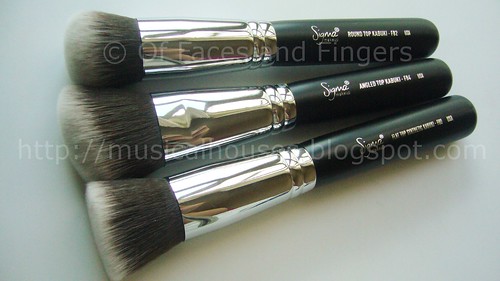
So what does this mean, if you're looking at all these kabukis? Well, denser bristles tend to translate into a heavier appication of product. So if you're looking to apply product with these, pick a denser-bristled brush if you want a heavier application, and vice versa. That said, since all three brushes are kabukis, application is granted to be a pretty heavy, so the variance isn't too large. If you're not looking to apply product, but just to buff out the product on your skin after application, then denser bristles tend to buff out products better, so once again, if this brush is purely for buffing, it would be better to pick a denser brush. However, once again, I'd caveat that since all these brushes are kabukis, they're all going to be dense - it's just how dense they are.
Lastly, there is shape. Brush shapes can be a little bit subjective to some extent, since someone's ideal bronzer brush can be another person's contouring brush. But personally, I'd use the Flat Top Synthetic Kabuki F80 for buffing in all-over face products, like foundation and powder, while I'd use the Angled Top Kabuki F84 for cheek products (blush, bronzer, contouring powder even), since it's handy angled shape would come in really useful for such functions. The Round Top Kabuki Brush F82, would be useful for any tight spots that require lots of buffing, since this brush is a very effective buffer.
Over the next couple of posts, I'll be comparing these brushes to the ones I currently already have in my stash, and doing comparisons for each of them in a bit more detail. But for now, if you need a good synthetic kabuki, these are actually worth looking into.
It can be pretty daunting picking from Sigma's wide array of makeup brushes. Sigma only does brushes and accessories, so you can imagine how specialized they are. They have a gazillion face brushes, so out of those I zoomed in on three that looked interesting. These are three kabuki brushes, in various shapes that intrigued me. While most brands only have one single kabuki brush, Sigma has three! How's that for variety?
The three kabuki brushes shown here are the Round Top Kabuki F82, the Angled Top Kabuki, F84, and the Flat Top Synthetic Kabuki, F80. They are arranged in that order from top to bottom in this photo:

Although only the Flat Top Synthetic Kabuki F80 lists itself as being synthetic, all three brushes are synthetic, and made of the same type of brush bristle. The bristles are actuay quite soft and well-formed, and remind me of the same synthetic bristles used by Too Faced and The Body Shop, two other brands with popular brands of synthetic brushes. The bristles are also very well-packed, as one might expect of a good quality kabuki brush - definitely no floppy bristles here! These brushes were definitely made to buff. Another thing I like about the bristles is that because they are synthetic, these brushes are good for applying not solely powder, but also cream, liquid, and gel products. Natural hair brushes tend to "soak up" liquid products, so for any liquid-based product, synthetic brushes tend to be more ideal.
The handles and ferrules of the brushes are also pretty sturdy - definitely no hair falling off, or no glue coming un-sticky. They were actually of much better quality than I expected them to be. The handles are all the same length, and are pretty uniform.
So now you must be wondering - if they're all kabukis, what's the difference between them? Well, first of all, there is shape. The Round Top Kabuki, Flat top Kabuki, and Angled Top Kabuki all have different shapes. Pretty obvious, right? But there is also bristle length. The Round Top Kabuki F82 is the brush with the shortest bristles, while the Angled Top Kabuki F84 has the longest bristles. Also, although all the brushes have tightly-packed bristles, there is still slight variance in the density of the bristles. The Round Top Kabuki has the densest bristles, while the Angled Top has the sparsest bristles.

So what does this mean, if you're looking at all these kabukis? Well, denser bristles tend to translate into a heavier appication of product. So if you're looking to apply product with these, pick a denser-bristled brush if you want a heavier application, and vice versa. That said, since all three brushes are kabukis, application is granted to be a pretty heavy, so the variance isn't too large. If you're not looking to apply product, but just to buff out the product on your skin after application, then denser bristles tend to buff out products better, so once again, if this brush is purely for buffing, it would be better to pick a denser brush. However, once again, I'd caveat that since all these brushes are kabukis, they're all going to be dense - it's just how dense they are.
Lastly, there is shape. Brush shapes can be a little bit subjective to some extent, since someone's ideal bronzer brush can be another person's contouring brush. But personally, I'd use the Flat Top Synthetic Kabuki F80 for buffing in all-over face products, like foundation and powder, while I'd use the Angled Top Kabuki F84 for cheek products (blush, bronzer, contouring powder even), since it's handy angled shape would come in really useful for such functions. The Round Top Kabuki Brush F82, would be useful for any tight spots that require lots of buffing, since this brush is a very effective buffer.
Over the next couple of posts, I'll be comparing these brushes to the ones I currently already have in my stash, and doing comparisons for each of them in a bit more detail. But for now, if you need a good synthetic kabuki, these are actually worth looking into.
Wednesday, October 20, 2010
Saturday, December 12, 2009
Face Brushes Review and Comparison 3: Flirt Feather Dust-her, Stila #8, Stila #21
Today is the last installment of my comparison and review of face brushes (Part 1 is HERE, and Part 2 is HERE). But you know what? Today I just spent a whole day swatching stuff, so I'm SO EXCITED about what I'm going to bring you! :) You'll love it, trust me ;) Starting tomorrow, I'm going to be posting swatches of ALL the Sleek iDivine palettes, one a day! :) So you're going to love it :)

Anyway on the topic of face brushes. Today we're reviewing the Flirt! Feather Dust-Her, the Stila #8, and the Stila #21, all of which are brushes which make my heart melt with delight everytime I see them.
First of all. The Flirt! brush is really nice, and it has bristles that are floppier and sparser than the 188. Unfortunately, this sparseness and floppiness means that it picks up...almost nothing. At least, that is if you're using it for powder. However, when used it for cream blushes, it gives the perfect application! I like how the soft bristles work well with all types of cream blushes, from the harder Bobbi Brown ones to the soft-as-mush Becca ones, but this one works with all of them. I think in this case the floppiness of the bristles works to its advantage - you don't get dots of cream blush on your face as might happen if the bristles of a skunk brush are too unwieldy, you just get a nice blended look. This is my HG brush for all cream blushes, although it's totally useless for powder.
Next, we have the Stila #8. This is just an ordinary powder brush, and it's definitely too big to be used for blush or highlighter or anything else - unless you happen to want to put it all over your face. But it does the job very well. There's something about this brush that totally kicks the ass of all my other powder brushes, including the MAC 134. For one, the bristles are not too dense, and not too sparse. And another thing is that the bristles are very soft. And another thing is that the dome shape is just right. This brush is a flat paddle powder brush, and I like how the dome shape works with that. Altogether, this is a very well constructed brush, especially for loose powder. Nothing compares to this baby. It's perfect, but it's also discontinued...*Shakes fist*
Lastly, we have the Stila #21. Unlike it's sister, it's actually still in production - so if you use pressed powder or blush, get this now! I love how I can use this for any and everything - except eyeshadow, LOL. For pressed powder or loose powder, I use the entire circular face of this brush, and for less pigmented blushes, I also 'stamp' on the brush using its circular face. For more pigmented blush, however, as well as for highlighters, I use the edge of the brush, and gently blend it in. Viola! Face done! I could use this for powder, then blush, then highlighter, and throw on some lippie and be out of the door, so this is really a great multi-tasker. It's really one of the best brushes there is!
So that concludes it for today! Starting tomorrow over the next 4 days, I will be posting SWATCHES OF THE SLEEK I-DIVINE PALETTES! So look out for it! :)

Anyway on the topic of face brushes. Today we're reviewing the Flirt! Feather Dust-Her, the Stila #8, and the Stila #21, all of which are brushes which make my heart melt with delight everytime I see them.
First of all. The Flirt! brush is really nice, and it has bristles that are floppier and sparser than the 188. Unfortunately, this sparseness and floppiness means that it picks up...almost nothing. At least, that is if you're using it for powder. However, when used it for cream blushes, it gives the perfect application! I like how the soft bristles work well with all types of cream blushes, from the harder Bobbi Brown ones to the soft-as-mush Becca ones, but this one works with all of them. I think in this case the floppiness of the bristles works to its advantage - you don't get dots of cream blush on your face as might happen if the bristles of a skunk brush are too unwieldy, you just get a nice blended look. This is my HG brush for all cream blushes, although it's totally useless for powder.
Next, we have the Stila #8. This is just an ordinary powder brush, and it's definitely too big to be used for blush or highlighter or anything else - unless you happen to want to put it all over your face. But it does the job very well. There's something about this brush that totally kicks the ass of all my other powder brushes, including the MAC 134. For one, the bristles are not too dense, and not too sparse. And another thing is that the bristles are very soft. And another thing is that the dome shape is just right. This brush is a flat paddle powder brush, and I like how the dome shape works with that. Altogether, this is a very well constructed brush, especially for loose powder. Nothing compares to this baby. It's perfect, but it's also discontinued...*Shakes fist*
Lastly, we have the Stila #21. Unlike it's sister, it's actually still in production - so if you use pressed powder or blush, get this now! I love how I can use this for any and everything - except eyeshadow, LOL. For pressed powder or loose powder, I use the entire circular face of this brush, and for less pigmented blushes, I also 'stamp' on the brush using its circular face. For more pigmented blush, however, as well as for highlighters, I use the edge of the brush, and gently blend it in. Viola! Face done! I could use this for powder, then blush, then highlighter, and throw on some lippie and be out of the door, so this is really a great multi-tasker. It's really one of the best brushes there is!
So that concludes it for today! Starting tomorrow over the next 4 days, I will be posting SWATCHES OF THE SLEEK I-DIVINE PALETTES! So look out for it! :)
Face Brushes Review and Comparison 2: MAC 188, Stila #24 and Body Shop Blush Brush

OK, so we had a nice diversion with Bourjois Brun Nylon. Now back to brushes: here's Part 2 of my face brushes review!
So in this previous post, I talked about the MAC 187 and 189, and how they were nice, but not really must-haves for me. Today, I will review and compare The Body Shop's synthetic blush brush, and the Stila #24. Just like how last post's brushes were all for face and foundation, today's brushes are all blush brushes!
The Body Shop has a really nice and soft range of synthetic brushes, comparable to the Too Faced ones in feel and quality, and I really like them for the face. I don't like them so much for eyes because sythetic brushes by their nature tend to pick up less pigment than natural hair brushes - this isn't so annoying when applying face powder or blush, when you want a sheerer application, but can be a pain if you're trying to put on eye colour, and you want the colour to show up. Thus, I tend to buy synthetic brushes for face use only. That said, I really like The Body Shop's version, for what it's worth. It has a nice dome shape, which fits into your cheek nicely, and it's nice to hold and use. I use this pretty often, especially for my more pigmented blushes, because like I said, the synthetic bristles pick up less pigment than, say the Stila #24, which is all natural hair. Although of course, if I reallly want a very sheer wash, I'd use my MAC #188 for that, because of its smaller size and it's sparse bristles. The only minor gripe I have with this is that the distribution of powder that it puts on your face isn't totally even. For some reason (I think it's because the dome shape ends abruptly at the sides - does that make sense? I can't think of a better way of putting it), it tends to put a greater amount of color in some areas than in others. It's not a big deal, because I just blend it out and it works well, but it's something I thought I'd just note. Like I said, it's a minor gripe.
The MAC 188 is of course, the little sister of the MAC 187, except, much better due to its smaller size. Here, like I mentioned above, it works reallly well for the most pigmented of blushes, like for example, your NARS Exhibit A. It also works fantastically for highlighters, especially for MSFs, because the sparse bristles work to prevent glitter overload. Very useful indeed. I like this one, and there's not much else to be said for this.
Last of all, the Stila #24 is a must-have for anyone who loves blush, but has a stash of mostly moderate-to-lightly pigmented blushes. Like the MAC 188, the Stila #24 is made out of natural hair, but the bristles are denser on both ends (duh!), and the larger end has a dome shape. If you look at the picture above you'll see that the larger domed end is actually just the right shape for blush - meaning that the brush itself isn't big, and the other end (which resembles a mini Stila #21), is really, really tiny. A lot of people ask me if the Stila #24 can be used for the entire face, like for face powder application, because they have been woefully misled by pictures on the Stila website, which somehow always seem to make the Stila #24 look a lot bigger than it is. You defintely won't be able to use this to powder your face, unless you're a pixie or something....Although it COULD double up as a powder blush if you want to squeeze one into your makeup bag, since its bristles are just the right type and density. It just would take a lot longer than using an actual powder brush, such as the Stila #8. Despite its smallness, I really like this brush! I love the rounded, domed end for powder blushes that aren't too pigmented, as it picks up just the right amount, deposits it evenly, and is just the right size for fitting on my cheek! And as for the other mini end? Wellllll....I'm not really sure what to do with it, and to be frankly honest, I rarely, if ever, use that tiny end. I do guess it would probably be good for powder highlighters, for spot highlighting. Otherwise, I can't think of a use for this - suggestions anyone? I do think the tiny end makes this brush a pity, since it is so expensive. I do love the bigger end, but I kind of think for USD$50, it isn't really worth the cost if you're not going to use the smaller end at all. The fact that I have it in my stash shows that I'm a sucker, I guess..
Anyway, that concludes Part 2 of my review and comparisons of face brushes for today. In Part 3, we will deal with the remaining brushes, which are all on my can't-live-without list, and you'll see why! :)
Thursday, December 10, 2009
Face Brushes Review and Comparison: Part 1 MAC 187 and 189
So I said in this post that I should do a post on my face brushes. And here you go! Over the next few days/weeks/however long it takes (with interruptions), I'll be doing reviews of my favourite brushes in my stash! Here they are. Not all of them are here, of course, but these are my favourites, my must-haves, and the ones I use the most often. Just a disclaimer: None of these brushes are free samples etc. I bought every single one of these with my own hard-earned money! I'm just reviewing them because...well they're in my stash, and well, a HG powder or blush brush can be the hardest thing to find sometimes, and it doesn't help that brushes tend to cost a lot of money:

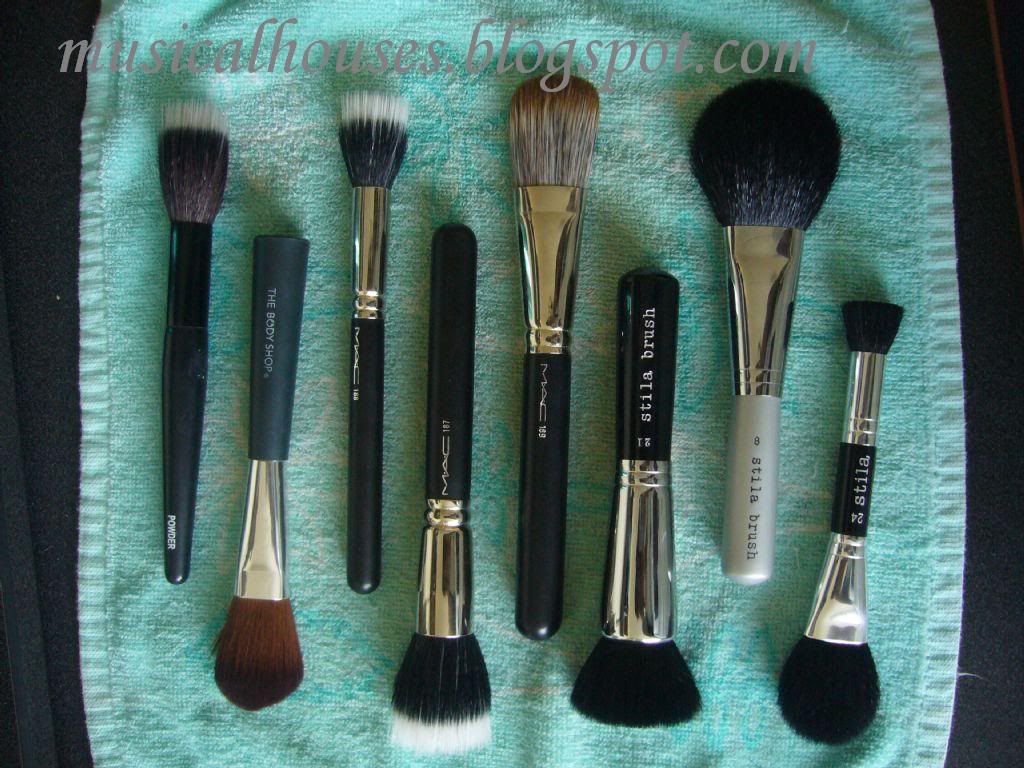
L - R: Flirt! Feather Dust-Her, Body Shop blush brush, MAC 188, MAC 187, MAC 189, Stila #21, Stila #8, Stila #24
So here they are, after being washed, mostly dry. I thought it would be a good idea to take all the face brushes together, to give an idea of scale and relative size, so you can get a good idea of how big/small one brush is next to another. Sadly, the Stila #8 has been discontinued, much to my chagrin, because it was one of the best powder brushes I've ever had (and this is after trying the MAC 134 and the Shu Uemura 18R). *Shakes fist* When I contacted Stila Customer Service about it, the jokers at CS told me to go and look at the Stila #31, which is NOT AT ALL like the #8. The #8 is much better in quality than the #31, but then again I have a thing against retractable brushes in general (except my Too Faced Kabuki - wait, why is it not in the picture? Nevermind, it gets it's own review, then I guess).
Anyway, today I will kick off my Face Brushes Series with a review of the MAC 189, and the MAC 187, because I don't have much to say about them. To be honest, they're the least used and the least favourite in the bunch, but that's probably just me.
The MAC 187 brush has reached cult status across makeupdom, and is the HG brush of many a liquid foundation user. Which herein lies why I don't like the MAC 187 as much as other people do - I don't use liquid foundation. I did use it to try to blend out my Kevin Aucoin Sensual Skin Enhancer, but somehow it didn't quite look 'right' even then. For blush application this is pretty good though - I like how the shape of the 187 fits just right onto my cheek area, not too small, and not too big. However, I tend to prefer the either the 188, the Stila #24, or the Body Shop blush brush, depending on what blushes I'm using (more on that in later reviews). So as a result, my 187 suffers from neglect. I do think this is a good quality brush though, it's just that the fact that I don't wear liquid foundation - coupled with the fact that I tend to use my other blush brushes over it - makes it rarely used.
The MAC 189 brush was first launched together with the MSF Naturals, and was touted as a blush that can be used for BOTH powder and cream. Now of course this flies against the face of all my makeup training and knowledge - traditional makeup theory says that synthetic brushes are best for cream, and natural brushes are best for powder, although of course in recent years the boundary has been blurred with the advent of better synthetic bristles etc etc. Anyway, I was curious to see how this worked for both powder and cream, and I have to say....I'm a bit ambivalent when it comes to poweder. Sure it applied face powder fairly well, but it just felt weird using a paddle synthetic brush to put on powder, if you know what I mean. I felt the finish was acceptable - it wasn't fantastic, but it wasn't le suckage either. I also tried using it for powder blush, but the effect wasn't as great as using an actualy blush brush, as the blending was a bit hard to do with the brush. I tried using this baby for cream blushes too, and once again, I found it a bit hard to blend out the cream blushes, as it tended to leave a hard line where the edges of the bristles were. Maybe I'm spoiled by all the skunk brushes out there, but this was just a meh for me. Not impressed.
So that's it for this brush post. I've no idea what brushes I'll cover for the next brush post, so feel free to comment and leave any suggestions :) I'll cover all of them eventually though :)

L - R: Flirt! Feather Dust-Her, Body Shop blush brush, MAC 188, MAC 187, MAC 189, Stila #21, Stila #8, Stila #24
So here they are, after being washed, mostly dry. I thought it would be a good idea to take all the face brushes together, to give an idea of scale and relative size, so you can get a good idea of how big/small one brush is next to another. Sadly, the Stila #8 has been discontinued, much to my chagrin, because it was one of the best powder brushes I've ever had (and this is after trying the MAC 134 and the Shu Uemura 18R). *Shakes fist* When I contacted Stila Customer Service about it, the jokers at CS told me to go and look at the Stila #31, which is NOT AT ALL like the #8. The #8 is much better in quality than the #31, but then again I have a thing against retractable brushes in general (except my Too Faced Kabuki - wait, why is it not in the picture? Nevermind, it gets it's own review, then I guess).
Anyway, today I will kick off my Face Brushes Series with a review of the MAC 189, and the MAC 187, because I don't have much to say about them. To be honest, they're the least used and the least favourite in the bunch, but that's probably just me.
The MAC 187 brush has reached cult status across makeupdom, and is the HG brush of many a liquid foundation user. Which herein lies why I don't like the MAC 187 as much as other people do - I don't use liquid foundation. I did use it to try to blend out my Kevin Aucoin Sensual Skin Enhancer, but somehow it didn't quite look 'right' even then. For blush application this is pretty good though - I like how the shape of the 187 fits just right onto my cheek area, not too small, and not too big. However, I tend to prefer the either the 188, the Stila #24, or the Body Shop blush brush, depending on what blushes I'm using (more on that in later reviews). So as a result, my 187 suffers from neglect. I do think this is a good quality brush though, it's just that the fact that I don't wear liquid foundation - coupled with the fact that I tend to use my other blush brushes over it - makes it rarely used.
The MAC 189 brush was first launched together with the MSF Naturals, and was touted as a blush that can be used for BOTH powder and cream. Now of course this flies against the face of all my makeup training and knowledge - traditional makeup theory says that synthetic brushes are best for cream, and natural brushes are best for powder, although of course in recent years the boundary has been blurred with the advent of better synthetic bristles etc etc. Anyway, I was curious to see how this worked for both powder and cream, and I have to say....I'm a bit ambivalent when it comes to poweder. Sure it applied face powder fairly well, but it just felt weird using a paddle synthetic brush to put on powder, if you know what I mean. I felt the finish was acceptable - it wasn't fantastic, but it wasn't le suckage either. I also tried using it for powder blush, but the effect wasn't as great as using an actualy blush brush, as the blending was a bit hard to do with the brush. I tried using this baby for cream blushes too, and once again, I found it a bit hard to blend out the cream blushes, as it tended to leave a hard line where the edges of the bristles were. Maybe I'm spoiled by all the skunk brushes out there, but this was just a meh for me. Not impressed.
So that's it for this brush post. I've no idea what brushes I'll cover for the next brush post, so feel free to comment and leave any suggestions :) I'll cover all of them eventually though :)
Labels:
Body Shop,
Brushes,
Comparison,
Flirt,
MAC,
Makeup,
Stila,
Unpaid/Unaffiliated Reviews
Subscribe to:
Posts (Atom)